Future-Ready Learning 2.0: Designing Spaces That Evolve as Fast as Students

Schools are forever striding into the future. So are students, but they’re sprinting. Equipping teachers for future-ready learning means designing educational spaces that evolve as fast as those sprinters. It begins with furniture.
But, wait a sec. Why furniture and not technology? Many educators now say future-ready learning isn’t about adding more tech. It’s about rethinking environments. Foremost is providing flexible physical spaces, and furniture is the most immediate, cost-effective way to do it.
This blog will elaborate on future-ready learning by looking at:
- What future-ready skills employers want
- Five characteristics of flexible space
- How to shop: key features of future-ready furniture
- Our top picks for future-ready Prek-12 school furniture
The Future is Now
First, let’s clarify the difference between Future-Ready Learning 1.0 and 2.0. Here’s one opinion.
Ten years ago, the U.S. Department of Education released an extensive report titled “Future Ready Learning: Reimagining the Role of Technology in Education.” The focus was heavy on the tech revolution, i.e., playing catch-up to the digital tsunami underway and preparing for its future.
Future-Ready Learning 2.0 accepts the future isn’t coming. It’s here. Technology is essential, but it needs calibrating to ensure educators are nurturing the whole student, which includes developing the hands-on and soft skills that employers need.
Future-Ready Skills: What Employers Want
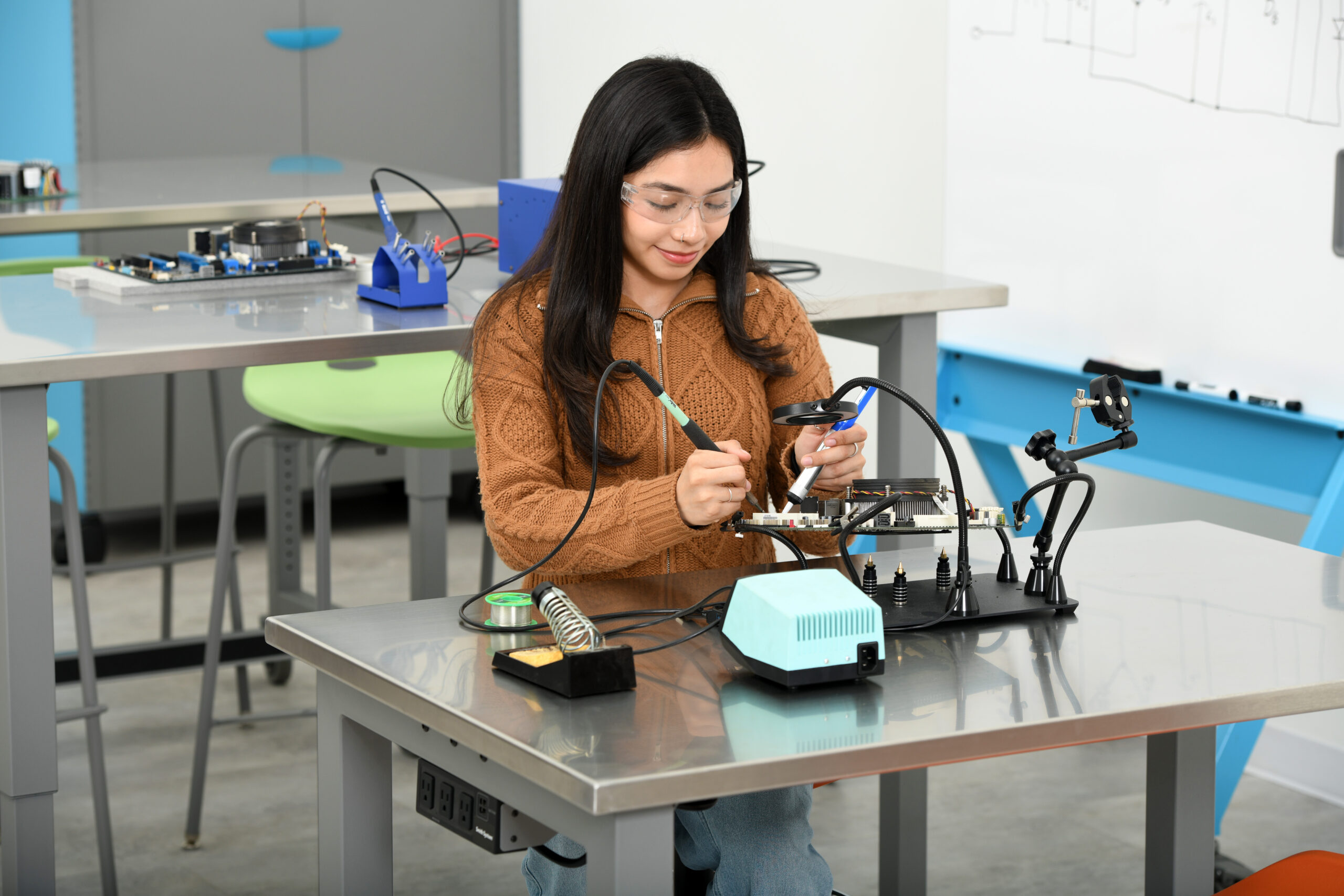
Technical skills and digital literacy are critical, especially in the age of AI. Yet, when asked where younger workers fall short, many employers name universal workforce skills — often called durable, non-cognitive, soft, or transferable skills. Think communication, problem-solving and collaboration. Also mentioned are adaptability, ability to focus, and empathy.
Educators at Bullitt County school district in Kentucky are hoping students graduate with these skills, in part, through more project- and community-based learning.
“We know there are certain things that are foundational, that students have to know and be able to do,” said Jesse Bacon, the Bullitt County superintendent. “But outside of that, what else do students need … to be successful?”
Larry Ferlozzo, author and an opinion contributor to Education Week, included this among his top 10 predictions for 2026: “By the end of the year, many school districts will realize that they have to take a big step back from ubiquitous student laptop use. In addition, the districts that are going all-in on generative AI will realize they have made a massive mistake. A tech counterrevolution will begin.” Only time will tell.
What’s Hindering Schools from Creating Future-Ready Classrooms
Peak inside a classroom, and you’ll see the reality for many teachers. They might juggle large-group discussions, peer collaboration, independent learning and tech-led instruction all in the same hour and space. Flexible classrooms with future-ready furniture are the steady rudder of that juggling act.
So, what could be hindering schools (beyond budget) from creating their future-ready foundation?
“Schools really struggle in creating future-ready spaces,” said Patrick McGiff, a market manager with One Workplace. It’s one of the country’s leading providers of integrated workplaces, including education.
Defining Flexibility: The Five Elements of Agility
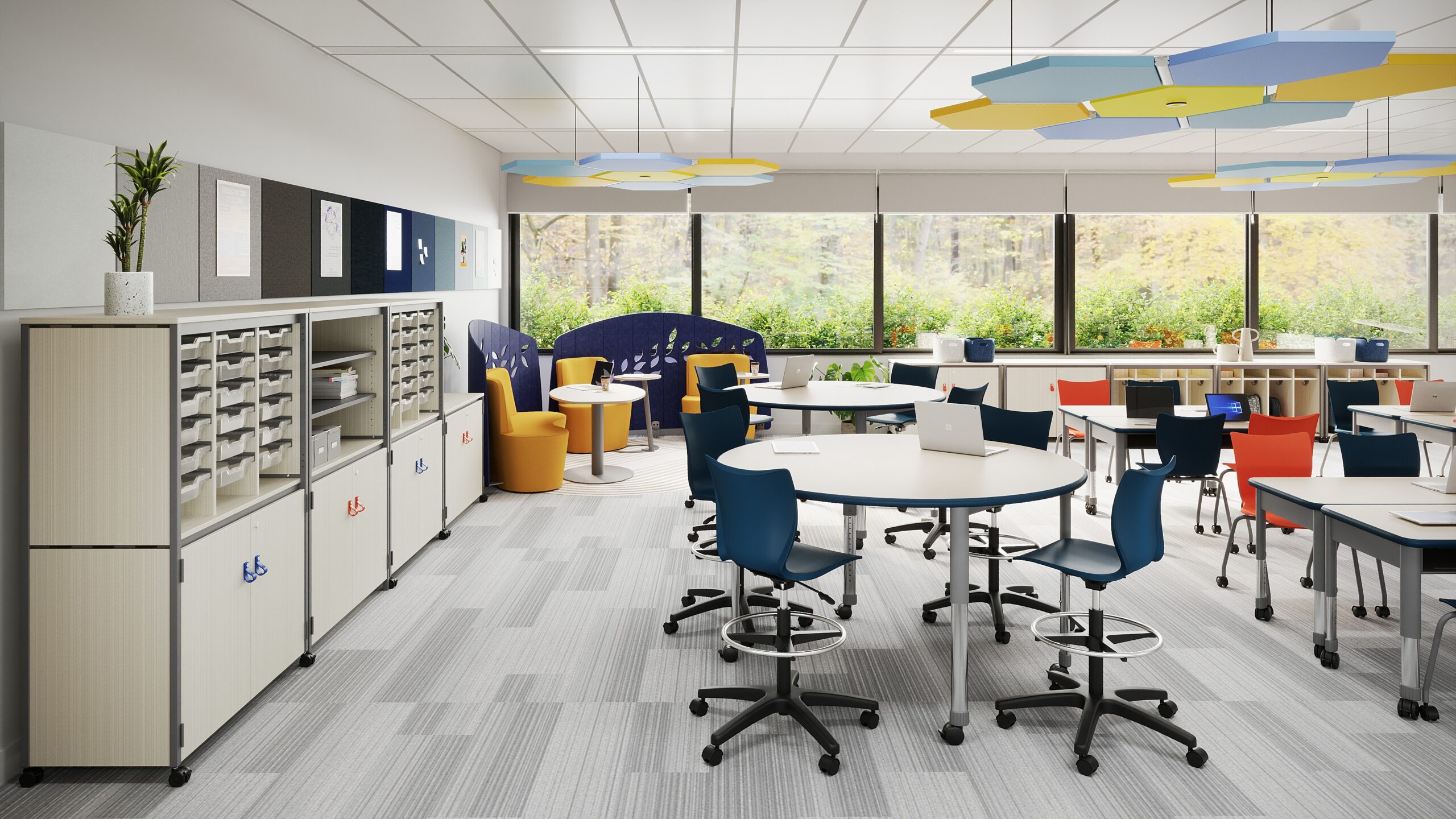
Schools can avoid costly mistakes by understanding what makes educational spaces flexible and future-ready. Teachers and support staff need agile, responsive educational classrooms, media centers, commons and more that, according to California’s Department of Education, are:
- Fluid – The space is uncluttered and allows for an easy flow of students, educators and learning/teaching tools, like seamless technology integration and connectivity. Fluidity can also mean taking learning outside.
- Versatile – The space can equip educators to embrace evolving instructional models and emerging trends, like AI, STEM/STEAM, project-based learning and personalized instruction.
- Convertible – The space can be adapted for entirely new uses. This is particularly relevant as more schools serve as community hubs for evening adult learning and meeting spaces. Maximize the ability for cafeterias, common areas and hallways to become multi-use zones.
- Scalable – Aspects of the space, like seating or work stations, can expand or contract to accommodate fluctuating class sizes, increase ADA accessibility, and ensure inclusivity of neurodivergent students.
- Modifiable – Students or teachers can easily and quickly manipulate the space – especially furniture – to the assignment, and multiple teaching modalities and learning styles.
Key Features of Future-Ready Furniture
The most immediate way to create flexible, future-ready learning spaces, is furniture. It’s foundational. The criteria for selecting the best furniture aligns with many of the spacial properties that define “flexible.”
Here’s how to shop for future-ready furniture. Chances are, your school has already begun furnishing its preK-12 spaces to maximize flexibility.
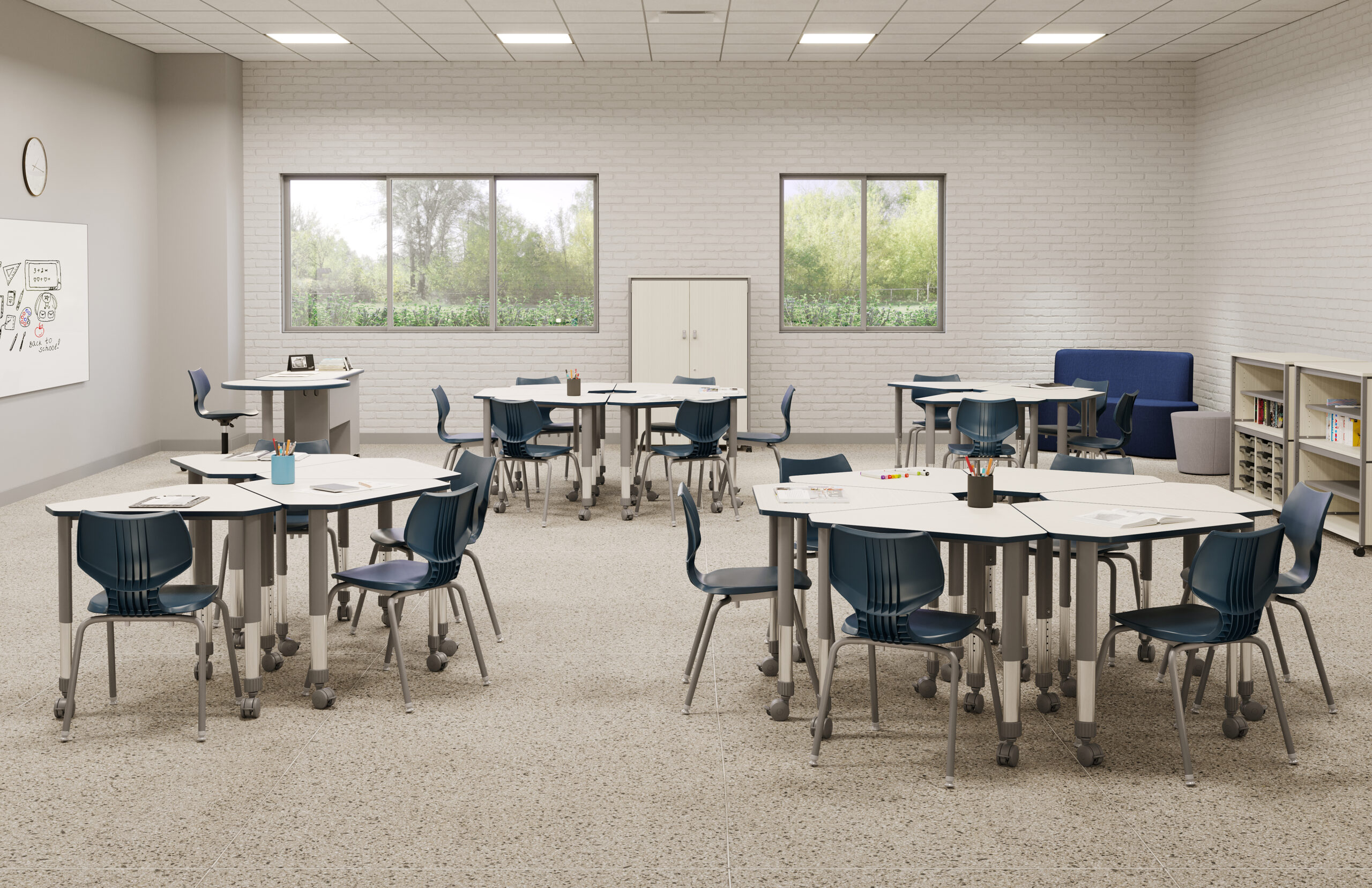
Versatile (Dual function and Reconfigurable). Select furniture with dual functions and practical features for transforming spaces to the subject, pedagogy and technology. Some examples include:
- Desks and tables for solo learning or, when tucked together, collaborative groups.
- Mobile, multi-purpose teacher desks, workstations and lecterns.
- Multi-functional storage units with attached white-board and removeable totes.
- Curved shelving that doubles as learning-zone dividers.
- Lounge seating students can reconfigure for solo focus sessions or group work.
- Weather-resistant Outdoor furniture that works both indoors and outside for student classrooms and teacher wellness breaks.
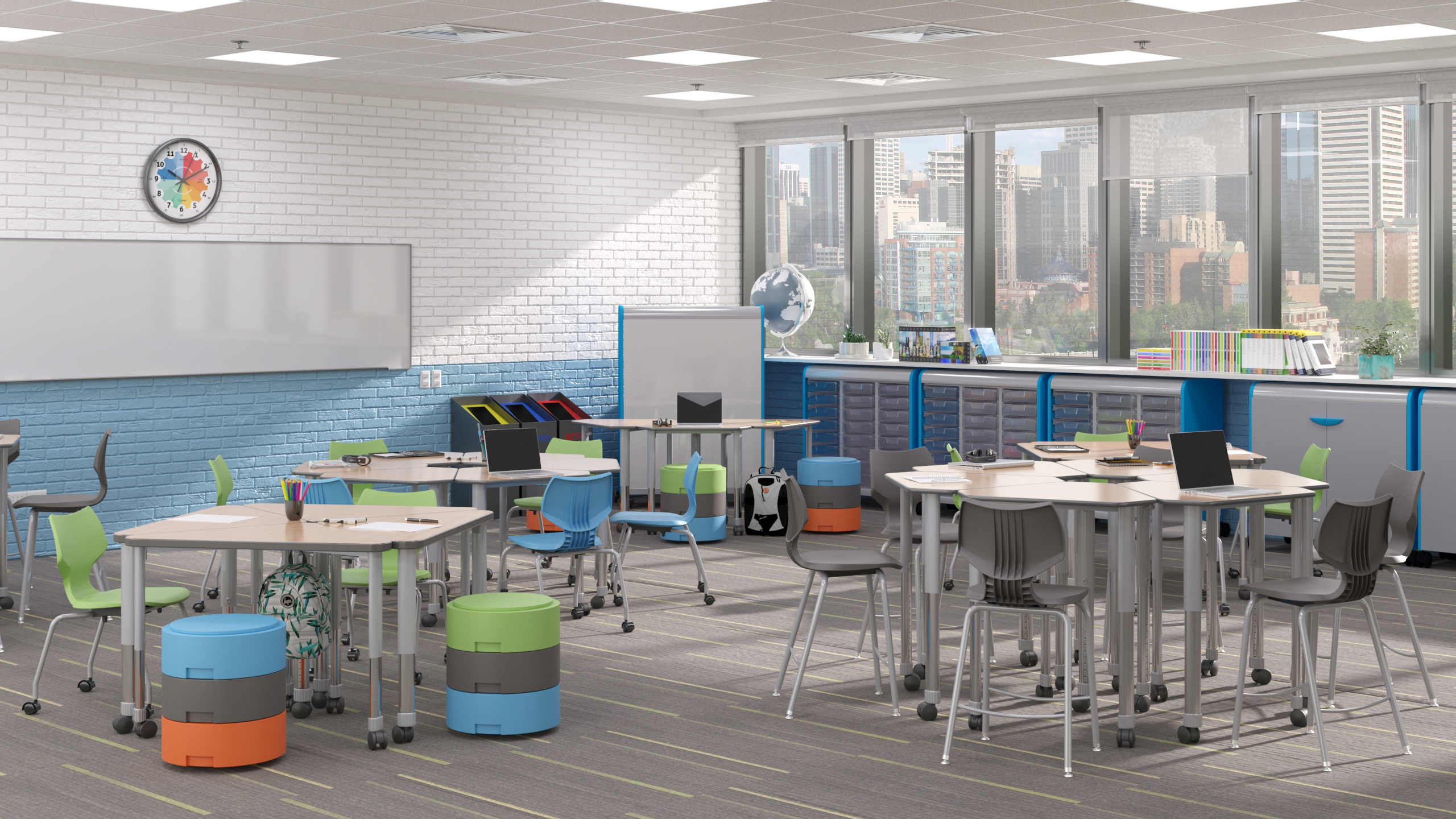
Mobility. Stay nimble with lighter-weight pieces that are safe and easy for one student to move. Consider casters for tables, chairs, desks and storage units for quick reconfiguring without damaging floors and walls.
Adjustable Height. Furniture should be comfortable, ergonomically supportive, and have the ability to accommodate different students and activities. Look for pneumatic or manually adjustable desks, tables, chairs and stools that students have agency to personalize to their size and ability.
Technology Integration. Digital fluency isn’t going away. Tables, desks and ottomans with built-in power, data ports, monitor mounts and charging stations can support laptops, tablets and the next iterations of interactive tech. Cable management is important, too.
Varied Seating. Provide a mix of seating options that empower students to choose how they learn and feel best physically, emotionally, socially, mentally. Curate ergonomic chairs with and without movement, soft-seating and floor cushions, wobble stools, and standing-height options for students with typical, special, neurodivergent and ADA needs.
Durable. Look for highly durable, versatile furnishings that can live up to changing roles over time.
Our Top Picks for Future-Ready Prek-12 Furniture
Smith System’s agile furniture ecosystems help schools build adaptable spaces that support what’s shaping educational furniture design. That includes innovation, wellness, hands-on discovery and digital fluency. When students feel supported in their environment, learning becomes more accessible and enjoyable. The same goes for teaching.
Here are a few favorites from Smith System’s furniture family:
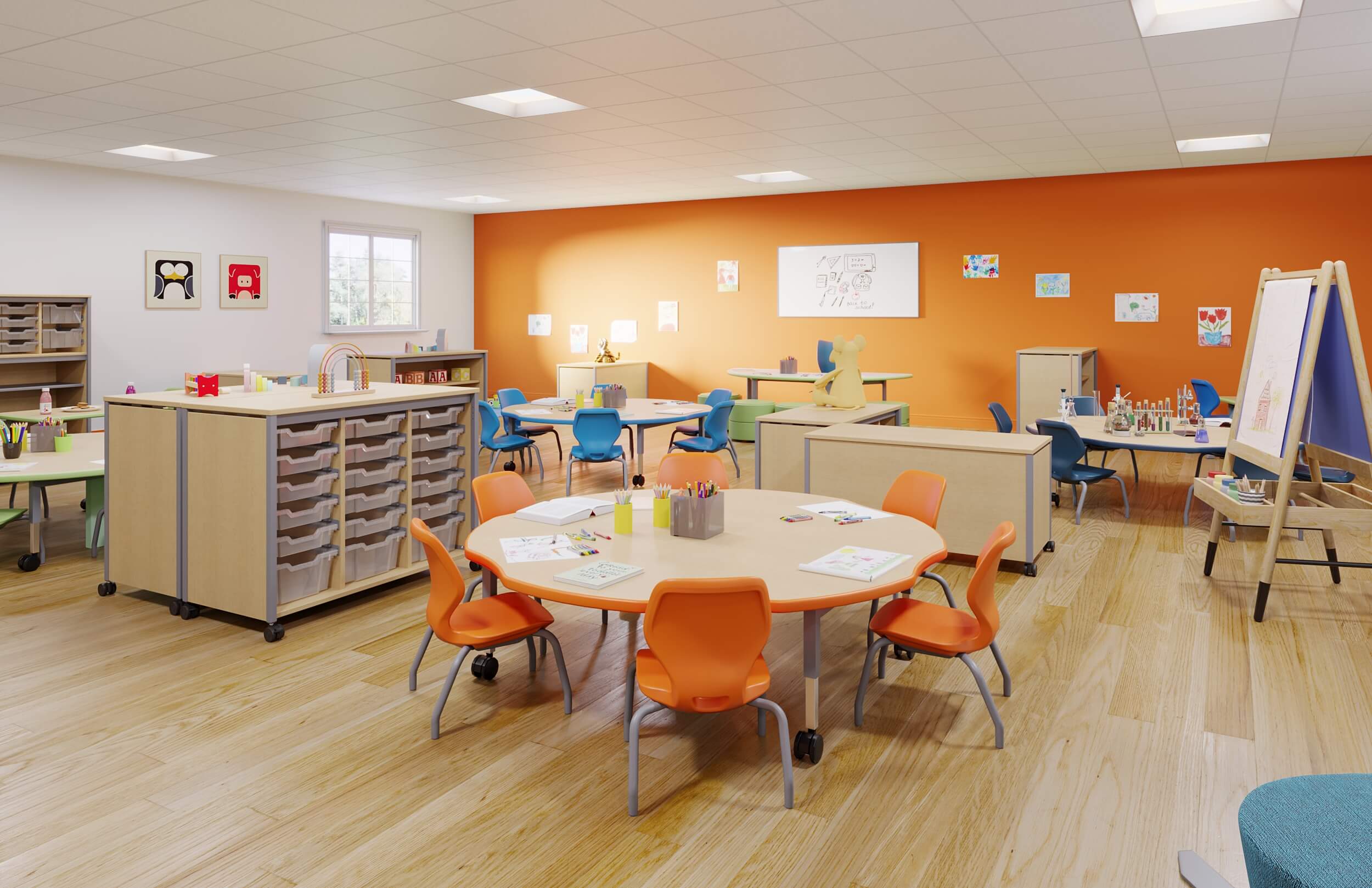
Adjustable Group Tables
Smith System's communal school tables and meeting tables are more than landing spots for elbows and laptops. They’re center stage for learning; the epicenter for collaboration and engagement, where students gather, spread out materials and start the discussion, with or without the teacher.
Smith System offers a broad spectrum of adjustable group tables. Choose from geometric and uniquely organic shapes; many have optional power. A few examples include:
- Planner® Flower Activity Table for small groups; 24” to 34” adjustable range
- Elemental® Rectangle Tables for medium groups; 21.5″ to 35.5″ adjustable range
- Interchange® Half Boat Multimedia Table can seat up to eight; 22” to 34” adjustable range or choose high-range leg inserts 30” to 42”
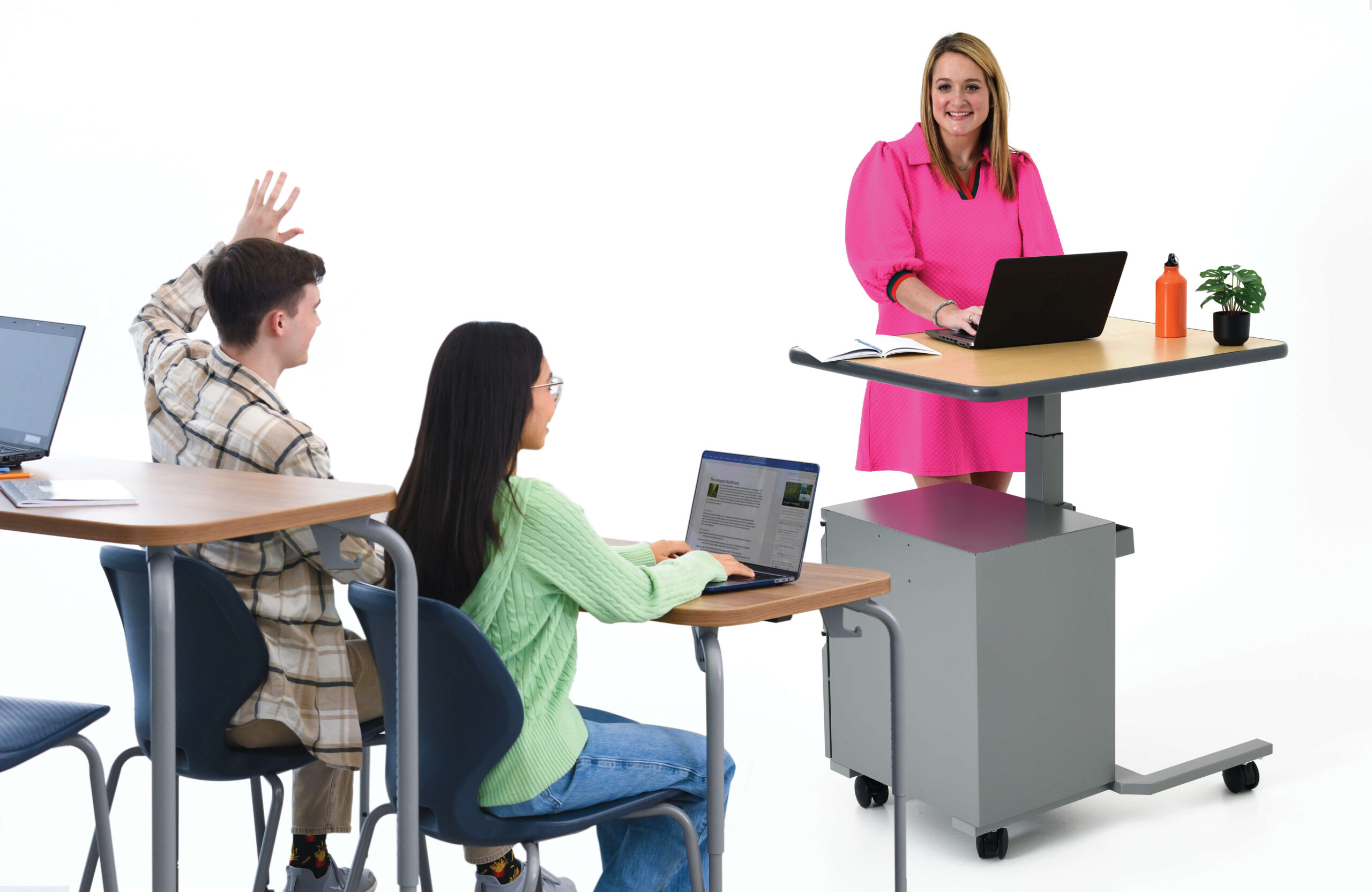
Mobile Teacher Workstations
It’s common for teachers to rotate through different rooms, based on subject schedule, shared resources and team-teaching needs. This can leave “nomadic” teachers without a consistent place to work, plan, or store materials.
The Cascade® Mobile Teacher Workstation is a new addition to our versatile line-up of teacher desks. It’s a portable homebase designed to help roving teachers stay organized and in charge.
The compact workstation is a practical solution. Highly flexible, the unit offers sit-to-stand height range and lockable storage drawers. Teachers can personalize by adding a modesty PET panel and integrated power.
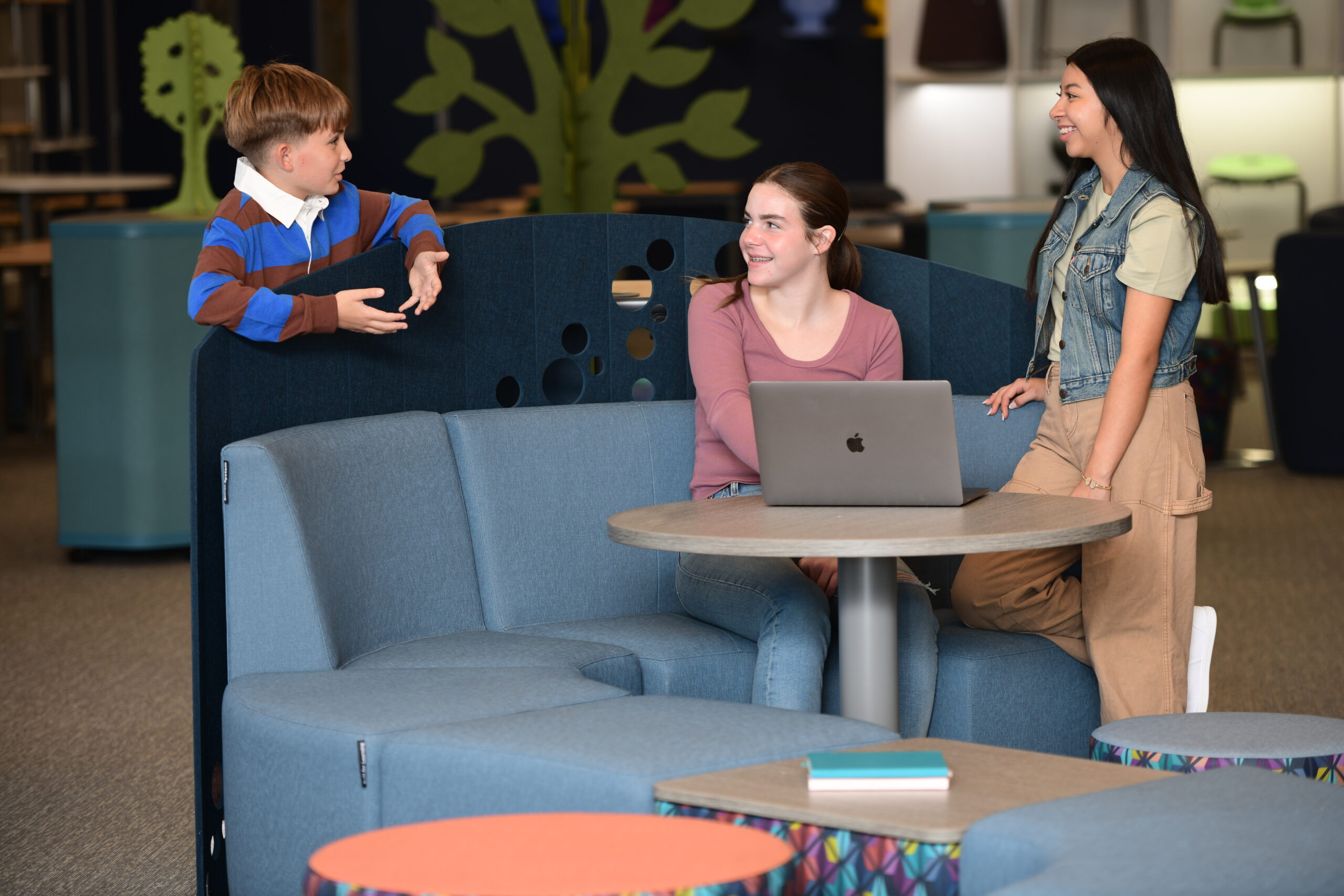
Modular Lounge Seating
Future-ready learning demands lounge seating deliver beyond comfort. Modern lounge seating has to master the art of the flexible layout. Flowform® Modular does that, with near-endless arrangement options.
It’s a mini-universe of upholstered – yet firm – seats, wedges, benches and ottomans (with power option). Their modular design, straight edges and casters allow users to easily customize their soft-seating configurations for focused learning in shared learning spaces.
Suitable for all grade levels, Flowform Modular is available in 15-inch-height for PreK–grade 3 and 18-inch-height for older students through high school. It’s easy to create group spaces, tutor areas, quiet zones for introverted learners, and calm corners to self-regulate.
We Help Create Educational Spaces That Evolve as Fast as Students
When designing educational facilities, architects often ask how a school can serve the community not just today, but 20 years from now. That mindset also applies to future-ready learning and the school furniture that enables it.
If districts want to be future-ready, it starts with creating the right environment: Highly flexible, versatile ecosystems that can evolve as fast as the savvy students who expect it.
Smith System is ready to help you create future-ready learning landscapes. Contact us today to begin your school furniture blueprint.
Sources
- https://files.eric.ed.gov/fulltext/ED571884.pdf
- https://www.edweek.org/policy-politics/opinion-larry-ferlazzos-10-education-predictions-for-2026/2025/12?utm_source=nl&utm_medium=eml&utm_campaign=pk12&M=16168316&UUID=e960eadb6653d880fd4b6020516eb571&T=21039948
- https://www.edweek.org/teaching-learning/even-in-academic-classes-schools-focus-on-building-students-workforce-skills/2024/10
- https://www.edweek.org/teaching-learning/we-asked-executives-what-skills-young-workers-are-missing-heres-what-they-said/2025/12
- https://www.edutopia.org/article/problem-based-learning-ai/
- https://saaarchitects.com/designing-educational-spaces/#:~:text=Flexibility%20is%20essential.,responsible%20but%20also%20economically%20intelligent.
- https://www.samuelsgroup.net/blog/classroom-furniture

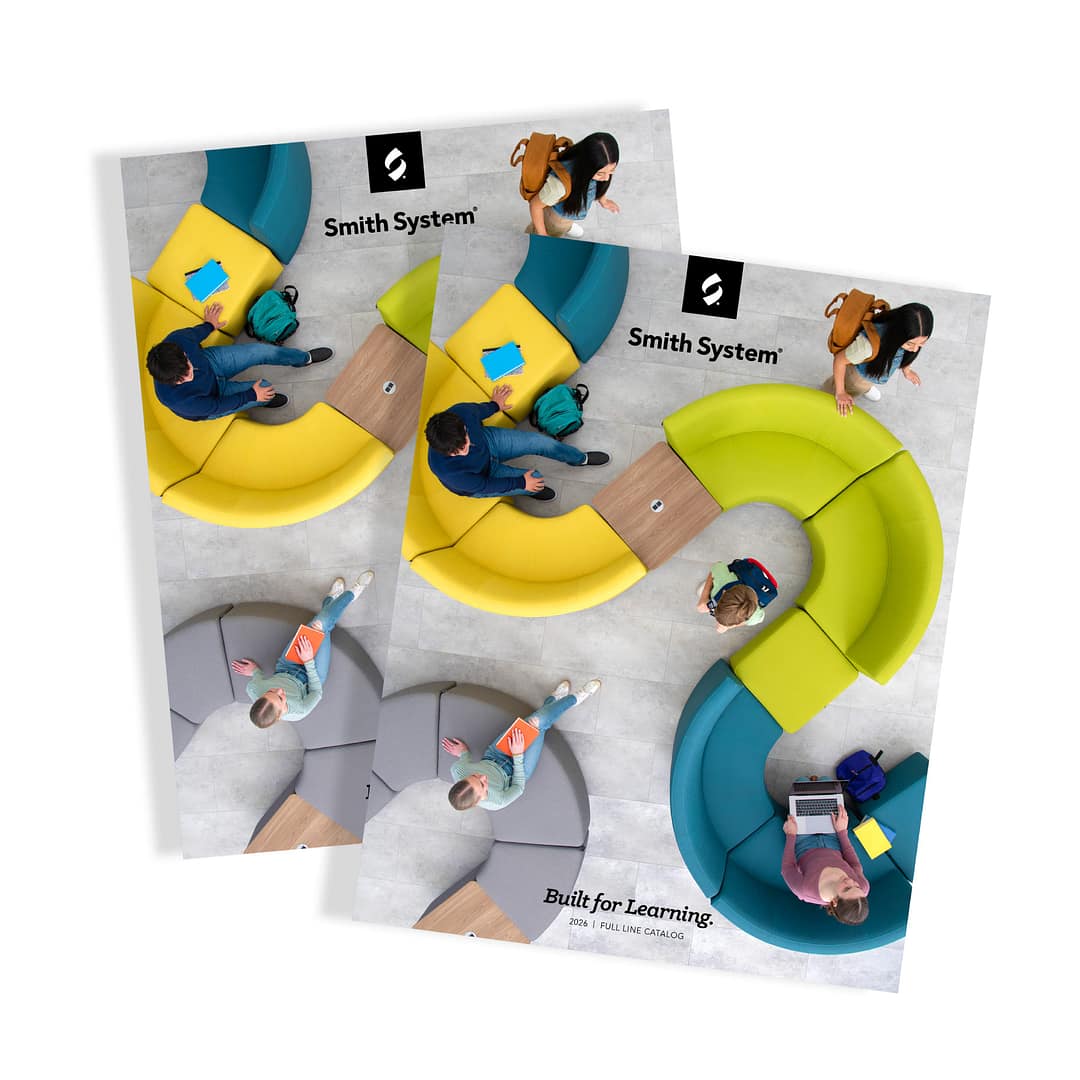
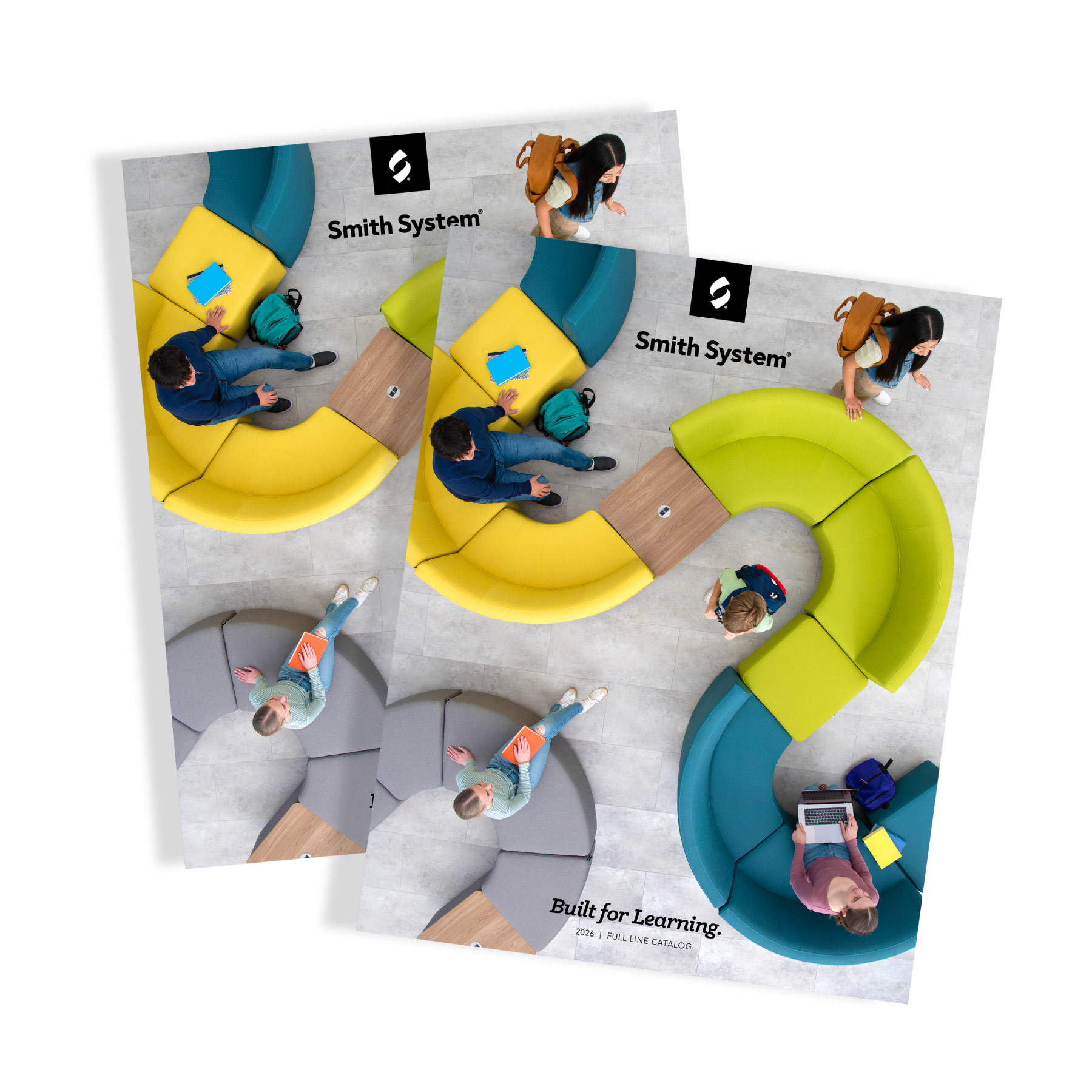
View our 2026 Catalog
Recent Posts
 Design Without Limits: Creating Schools That Feel Like Home with Custom Materials
 Back-to-School Classroom Tips That Set Students Up for Success
 Designing for Early Childhood: How Environment Shapes the Way Young Children Learn
 The Importance of School Furniture in Inclusive and Special Education Classrooms
 Designing CTE and Makerspaces for Learning Real-World Skills
 Designing Classrooms Around How Students Learn: The 4 Pillars
 Student-Centered Layouts & Storytelling
 Designing for Decades: The Future of Sustainable Learning Environments